Thermal Imaging Leak Detection in Pflugerville, TX
Thermal imaging uses an infrared camera to see heat from a hot water leak through tile, wood or carpet. We connect Pflugerville homeowners with local providers. Call (512) 877-2924.
Call (512) 877-2924- Free call, no obligation
- Phone answered 24/7
- Local provider explains cost before work
What happens when you call?
- 1Tell us what you see: a warm floor, a high bill, or running water.
- 2We connect you with a local provider who serves your area.
- 3The provider explains options and cost before any work starts.
When should you call about thermal imaging leak detection?
- A spot on the floor feels warm
- Your water heater runs more than usual
- Carpet is damp near a warm area
Not sure it is a slab leak? Call and describe what you are seeing. The call is free.
Call (512) 877-2924What should you do right now?
- Shut off the main water valve. It is in the meter box near the street, or where the main line enters your garage or an outside wall. Turn it clockwise until it stops.
- Warm floor? Close the cold-water inlet on top of the water heater.
- Water near outlets? Stay away. Switch off the breaker only if you are on dry ground.
- Smell gas? Leave and call your gas utility or 911 from outside.
What will the local provider do?
- Run hot water to build heat in the line
- Scan the floors with an infrared camera
- Confirm the spot with an acoustic check
- Mark the leak and explain options
Start with Pflugerville slab leak detection if you are not sure what you need.
What causes the problems thermal imaging leak detection finds?
Thermal imaging finds leaks that give off heat. In Pflugerville homes that almost always means the hot water side of the plumbing.
- Hot water lines expanding and contracting every day
- Copper wearing where it touches concrete under the slab
- Radiant heat lines or hydronic systems leaking
- Water heater supply lines leaking near the closet
Which warning signs matter most?
| Sign | What it may mean | Urgency |
|---|---|---|
| Warm patch on tile at odd hours | Hot water escaping under the slab | Today |
| Water heater cycles often with no use | Heat being lost to a leak | Today |
| Warm baseboard or lower wall | Hot line leaking inside a wall | Today |
| Energy bill rising slowly | Heater working to replace leaked water | This week |
What should you expect?
Before the scan, the provider may run hot water for a while to build heat in the line. The leak area then shows up as a warmer shape on the camera screen, which they confirm with an acoustic check.
How can you prevent it?
- Set the water heater to a moderate temperature to reduce pipe stress
- Insulate exposed hot water lines in the garage or attic
- Feel floors near the heater and kitchen every few months
- Have the heater and its connections checked when it is serviced
How does thermal imaging show a leak?
A thermal camera reads surface temperature and shows it as a color map. When hot water leaks under a slab, it warms the concrete above it, and the camera shows a warm patch spreading out from the leak. Cold water leaks can show up too, as a cooler or damp area, though the contrast is usually weaker.
The camera does not see through the floor. It reads the heat that has already reached the surface. That makes thermal imaging a fast way to scan a whole room and find where to focus, before acoustic or pressure tools confirm the exact point.
Technicians often run hot water for a while before scanning, so the leaking line heats up and the pattern becomes clear. They may also scan walls and ceilings, where a leak from a supply line in a wall can leave a cooler, damp stripe.
What can affect the image?
| Factor | Effect on the scan |
|---|---|
| Thick tile or stone | Spreads heat, so the patch looks wider |
| Rugs and carpet pad | Insulate the floor and hide the pattern |
| Sunlight through windows | Creates warm spots that are not leaks |
| Radiant heat or ducts in the slab | Show heat lines that can be mistaken for pipes |
| Cold water leak | Weaker contrast than a hot water leak |
A trained technician accounts for these. They may ask to close blinds, move rugs, or wait until the floor settles before scanning.
What are the benefits of thermal imaging?
- No contact with the floor, walls or pipes
- Covers a large area quickly
- Produces images you can keep with the detection report
- Helps confirm a hot water leak before the water heater runs constantly
- Can reveal moisture in walls and ceilings from other leaks
When is thermal imaging not enough on its own?
A warm floor has more than one possible cause. Sun exposure, a heating duct, or an appliance on the other side of a wall can all warm a patch of floor. Thermal imaging points to where to look. It works best alongside a pressure test, which confirms that a line is actually losing water, and acoustic listening, which narrows the spot.
Cold water leaks are harder to see, especially in summer when the slab and the water are close in temperature. In that case the provider may rely more on sound and tracer gas.
What should you do before the scan?
Avoid running the dishwasher, laundry or showers for a while before the visit unless the technician asks you to. Move rugs from the suspect area, and note where you have felt warmth, at what time of day, and whether it changes when the water heater is off. That record helps the technician tell a leak from a sunny spot.
Where else can a thermal scan help?
Thermal cameras are not only for floors. A scan of walls can show a supply line leaking inside a wall, which often looks like a cool, damp stripe running down from a fixture. Ceilings under upstairs bathrooms can show wet patches from a shower pan or toilet seal. Around the water heater, a scan can show whether heat is escaping along a line that should be idle.
These findings still need confirming. A damp wall can come from a roof or window leak as well as a pipe. The scan narrows where to look, and the provider explains what they think the source is and how they will check it.
What does a thermal image look like?
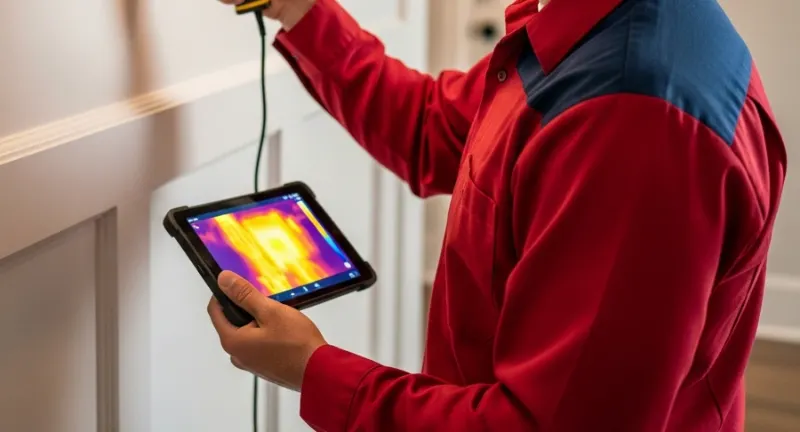
Most cameras show warm areas in yellow, orange or white and cool areas in blue or purple. A hot water slab leak often looks like a bright blob or a warm band following the pipe path. The technician adjusts the temperature range so small differences stand out. Ask them to explain the image with you, so you can see why they marked the spot they did.
Where in Pflugerville can you get thermal imaging leak detection?
- Slab leak detection in Blackhawk 78660
- Slab leak detection in Windermere 78660
- Slab leak detection in Falcon Pointe 78660
- Slab leak detection in Villages of Hidden Lake 78660
- Slab leak detection in Highland Park 78660
- Slab leak detection in Heatherwilde 78660
- Slab leak detection in Avalon 78660
- Slab leak detection in Sorento 78660
- Slab leak detection in Carmel 78660
- Slab leak detection in Springbrook 78660
- Slab leak detection in Commons at Rowe Lane 78660
- Slab leak detection in Northtown Park 78660
- Slab leak detection in Brookfield 78660
- Slab leak detection in Cambridge Heights 78664
- Slab leak detection in Park at Wellspoint 78664
- Slab leak detection in Verona 78660
- Slab leak detection in Bohls Place 78660
Related services
Thermal Imaging Leak Detection questions
Can thermal imaging find cold water leaks?
It works best on hot water lines. Cold leaks are usually found with acoustic tools instead.
Does the camera see through concrete?
It shows heat that reaches the floor surface. It does not see the pipe itself.
Which areas do you take thermal imaging leak detection calls from?
All of Pflugerville, TX, across ZIP codes 78660 and 78664.
Does it cost anything to call?
No. Pflugerville Slab Leak Specialists is a free referral service. The provider explains their costs before work starts.
Can thermal imaging see through carpet?
It can show heat that reaches the carpet surface, but thick padding can make the pattern weaker.
Is the infrared camera safe?
Yes. It only reads heat. It does not send out any radiation.
Why is an acoustic check used as well?
Heat can spread through concrete, so sound helps pin down the exact point of the leak.
Can a thermal camera see pipes under the slab?
No. It sees surface temperature. A leaking hot line warms the floor above it, and that is what shows up.
Does thermal imaging work on cold water leaks?
Sometimes. Cold leaks show weaker contrast, so they are usually confirmed with acoustic or pressure testing.
Will I get the images?
Many providers include thermal images in the detection report. Ask before the visit if you want copies.
How long does a thermal scan take?
The scan itself is often quick. Most of the visit goes to preparing the line, confirming findings and marking the spot.
Need help now?
Shut off the main valve if water is showing, then call. The phone is answered 24/7.
Call (512) 877-2924